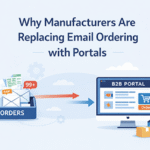
What Is an ERP-Integrated B2B Portal?
An ERP-integrated B2B portal is a secure online self-service platform that connects directly to a company’s ERP system. It allows customers, dealers, or partners to place and manage orders using real-time data from the ERP. Through the portal, users can:- View products and pricing relevant to them
- Place orders directly
- Check order status without contacting support
Where Manual Order Processing Breaks Down
Manual order processing often fails at multiple points:- Multiple order formats Orders come via email, spreadsheets, WhatsApp messages, or PDFs, making them hard to standardise.
- Manual data entry into ERP Operations teams retype order details, increasing the risk of errors in pricing, quantities, or delivery dates.
- Approval delays Orders requiring internal approvals get stuck in inboxes, slowing fulfilment.
- Order status confusion Customers frequently contact support to ask, “Has my order been processed?” or “When will it ship?”
- High administrative workload Teams spend hours each day managing follow-ups instead of focusing on higher-value tasks.
How ERP-Integrated B2B Portals Automate Order Processing
ERP-integrated B2B portals remove manual steps by creating a direct connection between customers and the ERP system. Here’s how the process typically works:- Customer logs into the portal Each customer sees ERP-driven products, pricing, and availability relevant to their account.
- Order is placed directly in the portal Customers select items, quantities, and delivery details without sending emails or spreadsheets.
- Order flows automatically into ERP The order is created in the ERP system instantly, with no manual re-entry.
- Approval workflows run automatically If approvals are required, they follow predefined business rules instead of email chains.
- Order status is visible to the customer Customers can track progress without contacting support.
Business Benefits for Manufacturers, Distributors, and Wholesalers
- Reduced Manual Work: By removing manual order entry, teams spend less time on repetitive tasks. This frees operations and sales teams to focus on customer relationships and process improvements.
- Improved Order Accuracy: Because orders are created directly from ERP data, pricing, quantities, and product details remain consistent. This significantly reduces errors and rework.
- Faster Order Processing: Orders no longer wait in inboxes. They reach the ERP system instantly, enabling faster fulfilment and better delivery performance.
- Lower Customer Support Load: With self-service order tracking, customers don’t need to call or email for updates. Support teams handle fewer routine queries.
- Better Customer Experience: Customers gain control and transparency. They can place orders, track progress, and manage their accounts without delays or back-and-forth communication.
Order Processing Without vs With an ERP-Integrated B2B Portal
| Without ERP-Integrated B2B Portal | With ERP-Integrated B2B Portal |
|---|---|
| Orders received via email, Excel, or PDFs | Orders placed directly through a self-service B2B portal |
| Manual entry of order details into ERP | Orders flow automatically into ERP |
| High risk of pricing and quantity errors | Accurate pricing and quantities pulled from ERP |
| Orders wait in inboxes for review or approval | Automated approval workflows trigger instantly |
| Customers call or email for order status | Customers track order status themselves |
| Operations team spends time fixing mistakes | Teams focus on fulfillment and customer service |
| Slower order processing and fulfillment | Faster, more predictable order turnaround |
| Limited visibility for customers | Real-time order visibility for customers |
Key Capabilities to Look for in an ERP-Integrated B2B Portal
When evaluating a B2B portal, businesses should focus on capabilities that support operations, not complexity:- Direct ERP-connected order creation
- Role-based access and approval workflows
- Order status and tracking visibility
- Customer-specific pricing and catalogues
- Clear audit trails for accountability